


Product managers face a constant problem: great ideas take too long to reach customers. Even with skilled engineers, teams lose weeks on repetitive tasks like summarizing feedback, writing specs, grooming backlogs, and coordinating releases. Agentic AI fixes this by handling entire workflows from start to finish, letting PMs focus on strategy while features ship four times faster.
Why Product Teams Are Slowing Down Even with Great Engineers
Product teams hit invisible roadblocks at every stage. Summarizing customer feedback from emails, support tickets, and reviews takes days. Prioritization debates drag because data sits in different tools. Writing detailed product requirement documents (PRDs) eats up a full week. Backlog grooming meetings run overtime as teams argue over story breakdowns. QA handoffs create confusion, and release coordination means chasing ten different people across Slack channels.
These delays have nothing to do with engineering skill. Engineers code fast when they get clear specs. The problem lies in all the coordination work that happens before and after coding. Product managers spend 40-50% of their time on administrative tasks instead of thinking about customers and strategy.
Adding more headcount makes things worse. New hires need weeks of ramp-up time and create even more meetings. More people means more communication overhead, not faster delivery. The real fix comes from automating the repetitive coordination work that consumes most of each sprint.
What Agentic AI Means for Product Management
Regular AI tools like ChatGPT answer questions but can't complete workflows. They give you a summary, then you copy-paste it into five different places. Agentic AI works differently. These systems get a goal, gather data from all your tools automatically, make decisions within clear boundaries, take actions like creating tickets or updating roadmaps, and improve based on feedback.
Think of agentic AI as coworkers who handle routine work end-to-end. A product manager says, "Summarize last week's feedback and update our roadmap." The agent pulls data from Intercom, Zendesk, and Slack, identifies the top three pain points, scores them by customer impact, and posts an updated roadmap to Jira with supporting evidence. The PM reviews and approves in two minutes instead of spending two days.
Agentic AI follows a simple four-step process:
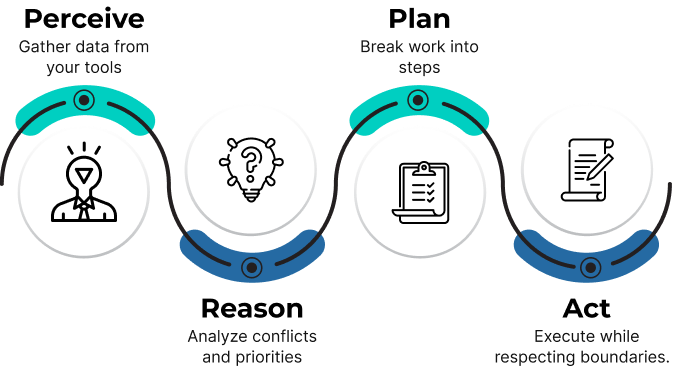
Product managers shift from doing the work to supervising smart systems that never forget details or miss deadlines.
Invimatic helps you with end-to-end agentic AI development for SaaS.

7 Product Workflows AI Agents Can Own End-to-End
Feedback analysis agents scan customer support tickets, app store reviews, Slack channels, and NPS surveys. They group complaints by theme, billing issues, slow performance, confusing UI, and rank them by how many customers mention each problem. The agent delivers a prioritized list with customer quotes and suggested fixes, ready for your next prioritization meeting.
Opportunity scoring agents pull usage data from analytics tools like Amplitude or Mixpanel. They compare feature adoption rates, identify unused premium features, and score new opportunities based on revenue potential, engineering effort, and strategic fit. Roadmaps update automatically with risk-adjusted timelines and resource needs.
PRD agents take a one-page brief or voice memo from stakeholders. They generate complete product requirement documents with problem statements, success metrics, wireframe suggestions, and technical acceptance criteria. Child stories appear in Jira with estimated effort levels and dependencies flagged automatically.
Sprint planning agents review your backlog against team velocity from the past six sprints. They suggest optimal story sizes, flag dependencies across teams, and create tickets with clear acceptance criteria. The agent assigns work based on developer availability and skill match, ready for Scrum Master approval.
Dependency mapping agents connect the dots between Jira tickets, GitHub pull requests, and CI/CD pipelines. They create visual maps showing which frontend work waits on backend APIs. Delivery risk alerts fire two weeks before deadlines when critical paths slip.
QA coordination agents track test coverage, bug escape rates, and production incidents. They generate release readiness checklists and block deployments when red flags appear, like missing edge case tests or unresolved high-priority bugs. No more manual status spreadsheets.
Release notes agents compile changelogs from GitHub commits, customer impact analysis from Jira stories, and migration instructions from technical docs. They format polished notes for customers and internal enablement teams, posted automatically to Slack and your changelog site.
A Practical "4x Faster Shipping" Playbook (30/60/90 Days)
Start simple in the first 30 days. Pick one workflow like feedback summarization. Connect the agent to your two most important tools, Jira for tickets and Intercom for customer feedback. Deploy in staging first, then measure how much time you save. Target 80% accuracy on pain point identification.
Days 31-60 add your product knowledge base through a system called RAG (Retrieval Augmented Generation). This grounds agents in your specific docs, past decisions, and company context. Add governance rules, who approves what, what gets logged for audits. Launch your PRD agent, aiming for a four-hour turnaround instead of two days.
By days 61-90, connect multiple agents that hand off work to each other. A feedback agent identifies issues, passes to a prioritization agent, which feeds a PRD agent. Dashboard metrics show cycle time dropping from eight weeks to two weeks. Roll out release notes automation across the entire company.
Guardrails Product Managers Must Require Before Letting Agents Act
Agents need strict access controls matching your current permissions. Engineers see code repositories, support agents access customer data, but nobody touches production databases without approval. High-impact actions like roadmap changes or release blocks always require human sign-off.
Define clear data boundaries upfront. Agents read customer feedback and usage analytics but never financial records or competitor pricing data unless explicitly permitted. Monthly permission audits prevent slow scope creep.
Every risky action pauses for human review. Creating new epics, blocking production deploys, or re-prioritizing quarter themes trigger Slack notifications with one-click approve/reject options. Product managers stay in control without constant babysitting.
Track four key metrics weekly:
- Accuracy (do humans agree with agent decisions?)
- Latency (how fast does work complete?)
- Cost (dollars per workflow)
- Drift (is performance degrading?)
Build vs Buy: When PM Teams Need Custom Agents
Buy simple summarization tools or basic copilots for one-off tasks like meeting notes. They handle generic work but fail when workflows span five different company tools or require business-specific logic.
Build custom agents when processes involve multi-step reasoning across Jira, Amplitude, Roadmunk, and your pricing model. Off-the-shelf solutions can't own your unique opportunity scoring or release readiness criteria. Custom agents integrate natively and scale with your growth.
Most teams run hybrid: bought tools for tactics, custom agents for strategy. Start with one custom agent controlling your highest-ROI workflow, then expand as confidence grows.
How Agentic AI Transforms Product Team Economics
Consider a typical SaaS product team of five PMs supporting 25 engineers. Each PM spends 20 hours weekly on coordination tasks that agents could handle. That's 4,000 hours annually across the team, equivalent to two full-time senior PMs tied up in admin work.
Redirect those hours to customer discovery, pricing strategy, and competitive positioning. Engineering velocity increases 40% because specs arrive complete and stories break cleanly. Quarterly OKRs become predictable because delivery risk visibility improves dramatically.
The real win compounds over time. Faster shipping means more customer experiments, quicker validation of assumptions, tighter product/market fit. Revenue growth accelerates because features reach paying customers months earlier. Churn drops as customers experience continuous improvement.
Agentic AI doesn't replace product managers, it makes them dramatically more effective. PMs shift from task-doers to strategy orchestrators. Engineers move from waiting to creating. Customers benefit from products that evolve weekly instead of quarterly. For end-to-end product agentic AI powered software product engineering, contact us today.





.svg)


.svg)
.avif)
Leave a Comment
Your email address will not be published. Required fields are marked *