


Enterprise leaders demand AI agents that deliver real business value without creating new risks. In 2026 and beyond, these systems must be compliant, secure, auditable, scalable, and predictable to handle mission-critical workflows. Simple chatbot-style agents no longer meet the bar for serious SaaS operations.
This guide outlines the essential capabilities that define enterprise-grade AI agents and helps technical leaders evaluate development partners.
What Makes an AI Agent "Enterprise-Grade"?
A basic AI agent handles single tasks and reacts to simple prompts. It might answer a question or format data, but that's where it stops. An enterprise-grade AI agent goes much further. It reasons through multi-step problems, respects role-based access controls, orchestrates multiple APIs, maintains complete audit logs, and stays fully compliant with organizational policies.
At its core, an enterprise-grade AI agent operates autonomously within critical workflows while aligning perfectly with your governance and security standards. These agents don't just respond, they plan, execute, collaborate, and learn while keeping every action traceable and secure.
Let’s take a look at the must-have capabilities for 2026:
Multi-Agent Collaboration & Orchestration
Enterprise workflows require teams of specialized agents working together seamlessly. One agent handles research while another validates data, and a third executes actions. They share memory and context across the group, so handoffs happen without losing critical details.
In SaaS platforms, this looks like an Engineering Agent passing validated code to a QA Agent, which then coordinates with a DevOps Agent for deployment. Support Agents collaborate with Knowledge Agents to resolve tickets while updating your CRM in real-time. This team-based approach scales complex workflows that single agents can't handle alone.
Real-Time Data Grounding (RAG 2.0)
AI hallucinations, when models invent facts, destroy trust in enterprise systems. Real-time data grounding solves this by connecting agents directly to live databases, logs, and APIs. Agents retrieve fresh data, rank sources by relevance, and cite exactly where information came from.
Advanced systems use hybrid retrieval combining vector search for semantic meaning with keyword matching for precision. Automatic context ranking ensures the most relevant information surfaces first. Every decision traces back to verifiable sources, which proves compliance during audits and builds confidence in automated actions.
Enterprise Security, RBAC & Zero Trust Controls
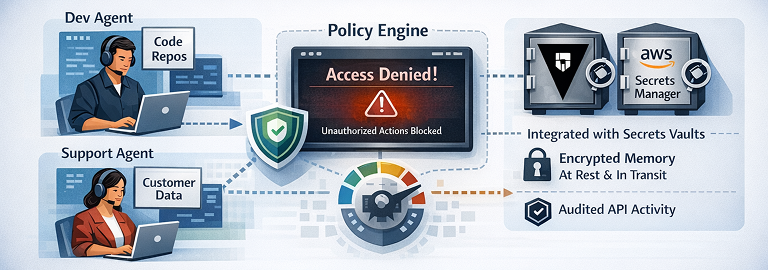
Security isn't optional, it's table stakes. Enterprise agents enforce Role-Based Access Controls so engineers see code repositories while support agents access only customer data. Policy engines block unauthorized actions before they execute.
Agents integrate with secrets vaults like HashiCorp Vault or AWS Secrets Manager, never hardcoding credentials. All memory stays encrypted at rest and in transit. No API calls happen without tracking, and systems support SOC 2, HIPAA, and GDPR out of the box. Zero trust means continuous verification, not one-time checks.
Autonomy With Guardrails
True autonomy means agents handle end-to-end workflows without constant supervision. They break complex tasks into steps, execute safely, and escalate only when predefined rules trigger. Action validation layers double-check every move against business policies.
Reasoning becomes visible through step-by-step logs showing how agents reached decisions. Human-in-the-loop checkpoints pause at critical moments, like code deployments or financial transactions, for approval. In SaaS environments, this enables safe automation of code reviews, infrastructure monitoring, and user lifecycle management.
Observability, Versioning & Audit Logs
Executives need proof that AI investments deliver results. Enterprise agents provide complete observability through event logs capturing every decision, action, and data source. Version control tracks agent behavior changes, so you can rollback problematic updates instantly.
Monitoring dashboards show real-time performance metrics, error rates, and cost consumption. Drift detection alerts when agent behavior deviates from expected patterns. Auditors access tamper-proof logs proving compliance without manual reconstruction. This transparency separates production systems from science projects.
Scalability & Multi-Tenant Deployment
SaaS companies serve thousands of customers simultaneously. Enterprise agents scale horizontally across containerized environments, handling traffic spikes without downtime. Stateless execution means any agent instance can pick up any task.
Multi-tenant isolation keeps customer data strictly separated while sharing underlying infrastructure efficiently. Load balancers distribute workloads intelligently, and distributed workflow engines coordinate agents across regions. High availability designs eliminate single points of failure, ensuring 99.99% uptime for critical operations.
Human Collaboration Layer
The best agents augment teams, not replace them. Collaboration layers let humans comment on agent suggestions, provide feedback that improves future performance, and see plain-English explanations of complex reasoning. Agents remember team preferences and adapt over time.
Deep integrations with Slack, Jira, GitHub, and Notion mean agents participate naturally in existing workflows. Engineers get pull request reviews with explanations. Product managers receive summarized customer insights in their daily Slack channels. This coworker-style interaction drives adoption across technical and non-technical teams.
Cross-System Integration & API Orchestration
Modern enterprises run on dozens of interconnected systems. Agents orchestrate workflows across CRM, ERP, billing platforms, support systems, logs, and CI/CD pipelines without custom glue code. API chaining executes sequences reliably with built-in retry logic and error handling.
Webhooks trigger agents instantly when events occur, like new support tickets or payment failures. Event-driven architecture responds to real-time business signals rather than scheduled polling. This end-to-end orchestration eliminates silos and accelerates business processes dramatically.
Get in touch with our experts for end-to-end AI Agent development for SaaS. Scale faster with Agentic.

The 2026 Standard Checklist
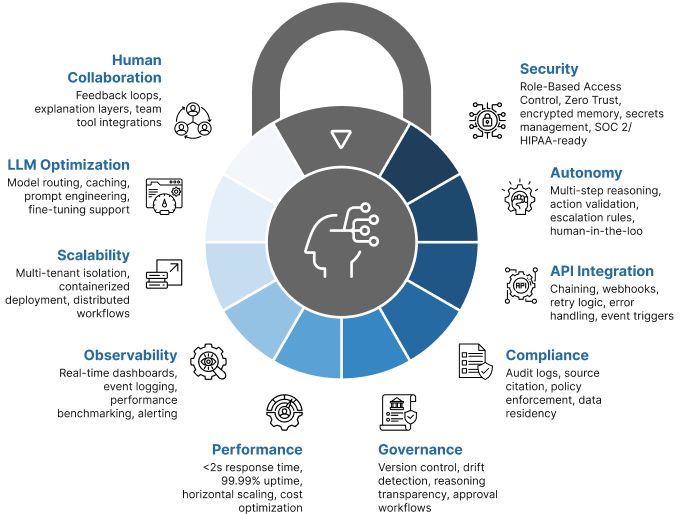
Use this comprehensive checklist to evaluate AI agent capabilities before selecting a development partner:
Build vs Buy: The Strategic Decision
Basic agents for support ticketing or knowledge retrieval? Buy proven solutions and focus internal teams on differentiation. Mission-critical workflows touching core IP, financial systems, or compliance? Build custom agents leveraging your unique data and processes.
Most enterprises land in the middle, buying foundational agents while building specialized ones for competitive advantage. The best partners offer both: production-ready platforms with deep customization for your specific requirements.
Why Invimatic Delivers Enterprise-Grade AI Agents
Invimatic builds AI agents that meet every enterprise-grade standard outlined above. Our secure multi-agent systems handle complex SaaS workflows with SOC 2-ready pipelines and scalable architectures. Enterprise controls and governance sit at the core of every deployment.
From end-to-end product engineering to production operations, Invimatic delivers agents that engineering teams trust and executives can stake their careers on. Build future-proof AI agents for your enterprise, contact us today and discover how Invimatic transforms agentic AI from promise to production reality.




.svg)


.svg)
.avif)
Leave a Comment
Your email address will not be published. Required fields are marked *