



Agentic AI
How SaaS Teams Can Plan an Agentic AI Project: Templates, Costs & Timelines
Most Agentic AI projects don’t fail because of weak models or immature tooling. They fail because teams start building before they finish planning.
Common issues include unclear scope, missing templates, undefined ownership, and underestimated integration effort. Agentic AI systems operate across multiple steps, tools, and decision points. Without a structured project plan, teams often end up with prototypes that look impressive. but never reach stable, production-ready maturity.
SaaS teams that succeed with Agentic AI approach it as a delivery initiative, not an experiment. That means defining scope early, aligning on outcomes, and planning costs and timelines before a single line of production code is written.
What Goes Into an Agentic AI Project?
An Agentic AI project is a system, not a feature. At a minimum, it includes:
- Goal definition focused on business outcomes, not “building AI”
- User workflows and functional steps the agent must follow
- LLM and agent framework selection based on workload and constraints
- Data preparation and retrieval strategy (RAG or non-RAG)
- Security, access control, and governance boundaries
- Integration scope (Jira, GitHub, Slack, databases, internal APIs)
- Human-in-the-loop checkpoints for approvals or overrides
Skipping any of these elements almost always results in rework later.
The Complete Agentic AI Project Planning Framework
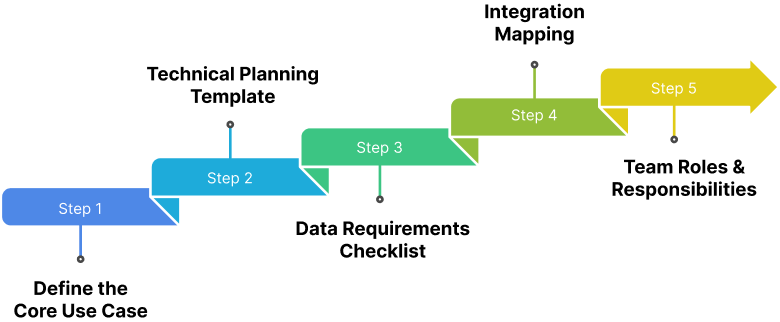
Step 1: Define the Core Use Case
Every Agentic AI project should begin with a single, well-defined use case.
1. Use Case Template
- Objective: What business problem does the agent solve?
- Users:Who interacts with or benefits from the agent?
- Trigger Event:What initiates the agent’s workflow?
- Agent Abilities (Actions):What can the agent read, write, decide, or execute?
- Success Metrics:How will success be measured?
- Dependencies:Systems, data, or approvals required
- Constraints:Cost, latency, security, or accuracy limits
2. Common SaaS Use Case Examples
- QA automation agent
- Knowledge retrieval agent
- Analytics anomaly detection agent
- Release note automation agent
Starting narrow reduces complexity and increases the likelihood of production success.
Step 2: Technical Planning Template
Once the use case is clear, define how the agent works internally.
1. Technical Architecture Template
- Input sources (events, APIs, documents)
- RAG vs. non-RAG decision
- Step-by-step agent workflow
- System integrations
- Edge-case handling
- Fail-safe logic
- Human approval checkpoints
This step prevents costly architectural changes mid-project.
Step 3: Data Requirements Checklist
Agentic AI performance depends heavily on data availability and quality.
1. Checklist
- Required datasets
- Pre-processing needs
- Data quality assessment
- Access permissions
- API readiness
- Historical vs. real-time data requirements
Planning data early avoids unreliable or inconsistent agent behavior later.
Step 4: Integration Mapping
Most SaaS Agentic AI projects span multiple systems.
1. Typical Integrations
- Jira
- GitHub or Bitbucket
- Slack
- HubSpot
- Zendesk
- Databases
- Custom internal APIs
Each integration requires defined permissions, error handling, and rate limits.
Step 5: Team Roles & Responsibilities
Agentic AI projects are inherently cross-functional.
1. Team Structure Template
- AI Architect: Designs system architecture and agent boundaries
- Data Engineer: Prepares datasets and retrieval pipelines
- LLM Engineer: Optimizes prompts, models, and inference behavior
- Agent Workflow Designer: Defines reasoning steps and decision logic
- Product Manager: Owns scope, KPIs, and business alignment
- DevOps Engineer: Handles deployment, monitoring, and cost controls
- QA/Test Lead: Validates agent behavior across edge cases
Clear ownership keeps delivery predictable and aligned.
How Much Does an Agentic AI Project Cost?
The cost of an Agentic AI project varies widely based on system design and integration depth. There is no one-size-fits-all pricing because Agentic AI systems differ in autonomy, complexity, and operational scope.
Projects with a single, focused workflow, such as internal productivity or knowledge automation, are typically simpler and faster to deliver. As the number of workflows increases, and as agents interact with more systems or make higher-impact decisions, the effort required grows accordingly.
Larger initiatives that span multiple teams or functions often require additional orchestration logic, monitoring layers, and governance controls. These systems resemble long-term platforms more than standalone features and should be planned with that mindset.
Key cost drivers include:
- Complexity of agent workflows and decision logic
- Model usage patterns and optimization needs
- Whether retrieval-based knowledge (RAG) is required
- Depth and number of system integrations
- Infrastructure, monitoring, and ongoing tuning requirements
Because of these variables, accurate cost estimation requires a clear understanding of your use case, data readiness, and desired level of autonomy.
Get a Quote Tell us your use case and scope to get a tailored estimate.
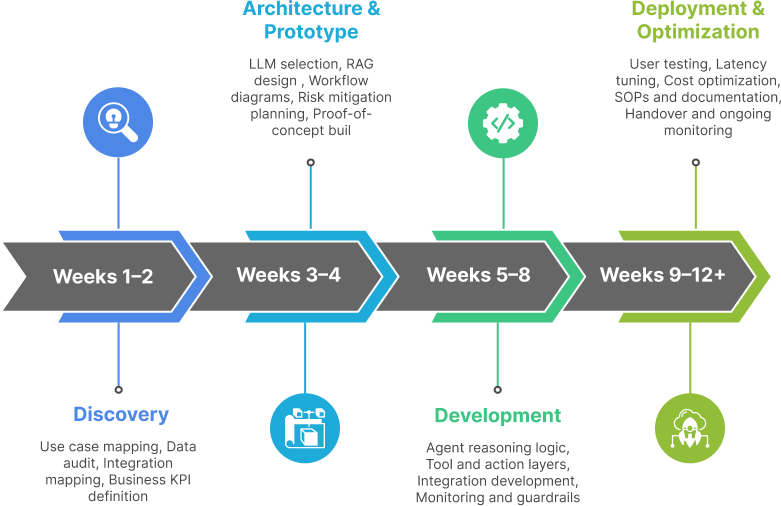
Sample Project Timeline for SaaS Teams
Common Mistakes to Avoid
- Starting with an over-ambitious v1
- Not preparing datasets early
- Ignoring governance and oversight
- Missing fallback actions
- Skipping discovery, leading to scope creep
Conclusion: Build Agents Like Systems, Not Experiments
Agentic AI delivers real value when treated as a structured delivery initiative, not a proof-of-concept exercise.
Clear templates reduce execution risk. Defined scope accelerates development. Thoughtful planning ensures agents remain stable, scalable, and trustworthy as usage grows.
At Invimatic, we help SaaS teams plan, build, and scale Agentic AI systems with clarity and predictability, covering everything from strategy and architecture to deployment and long-term optimization.
Our teams bring hands-on experience across engineering agents, RAG-driven knowledge agents, support automation, and analytics systems, supported by a proven delivery model tailored for SaaS environments.
Because the SaaS teams that plan first don’t just build agents, they build systems that last.




Your email address will not be published. Required fields are marked *