

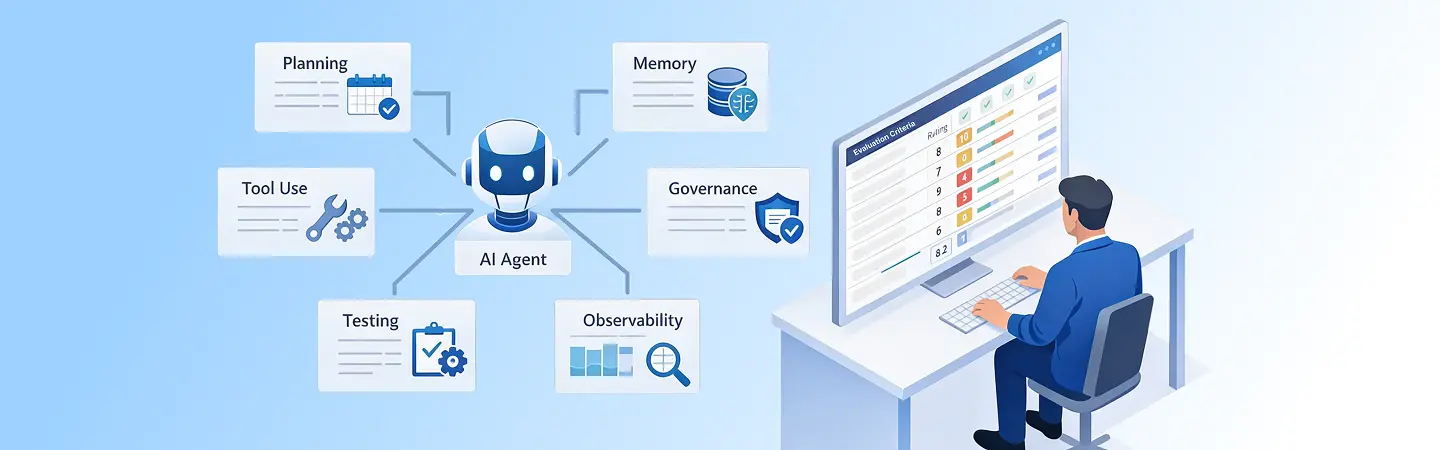
As a SaaS owner, you’re likely exhausted by the "AI-in-a-box" pitches hitting your inbox daily. Everyone claims to be an AI agent development company for SaaS, but here’s the reality: Agentic AI development for SaaS is fundamentally different from building a simple chatbot or a CRUD app.
You’ve seen enough tech cycles (Cloud, Crypto, No-Code) to know that the loudest voices aren't always the best builders. This guide is designed to help you cut through the vendor noise and choose a partner who actually understands AI agent development for SaaS platforms.
Why Choosing the Wrong Agentic AI Partner Is a Costly SaaS Mistake
Rushing into a partnership without a rigorous vetting process is a recipe for "Pilot Purgatory." In 2025, Forrester reported that nearly 60% of AI pilots failed, not because the tech didn't work, but because the implementation was shallow.
SaaS companies integrating Agentic AI face unique risks that traditional software projects don't:
- Failed Pilots: Vendors who treat agents like chatbots often deliver systems that "hallucinate" in production.
- Security Risks: Without deep architecture knowledge, an agent could inadvertently expose PII or cross-tenant data.
- The $500K Hole: Choosing a partner that builds "hacks" leads to unscalable code that has to be rewritten from scratch within 12 months.
Agentic AI for Product Managers: How to Ship Features 4x Faster

What Makes Agentic AI Projects Different From Traditional AI Development
To evaluate an Agentic AI development partner, you first have to understand what you're actually buying. Traditional AI is reactive (you ask, it answers). Agentic AI is proactive (it reasons, plans, and executes).
True agentic systems require:
- Multi-step Reasoning: The ability to break a complex goal into 10 smaller tasks.
- Tool & API Orchestration: Actually "using" your software, Jira, or Salesforce, not just talking about them.
- Memory & Context: Remembering what happened in Step 1 to inform Step 9.
- Human-in-the-Loop: Knowing exactly when to stop and ask you for permission before taking a high-stakes action.
AI agent development for SaaS, built for scale, security, and real-world workflows.
The Agentic AI Partner Evaluation Checklist
Use this checklist to evaluate any Agentic AI development services provider objectively. If they can't give you straight answers on these seven points, they are likely learning on your dime.
1. Agentic AI Architecture Expertise
Don't just look for AI experience. Look for Agentic experience.
- Do they use multi-agent frameworks like LangGraph or crewAI?
- Do they use RAG (Retrieval-Augmented Generation) to ground the agent in your specific data?
- Can they explain how they handle loops, where an agent gets stuck and needs to course-correct?
2. SaaS-Specific Product Experience
Building an agent for a hobbyist is easy. Building one for a multi-tenant SaaS platform is hard.
- How do they ensure Tenant A’s agent can’t see Tenant B’s data?
- Do they understand SaaS metrics? Can they build agents that specifically target churn prediction or usage analytics?
3. Integration & API Orchestration Capability
An agent is only as good as its "hands."
- Can they natively integrate with your stack (Slack, GitHub, Salesforce)?
- How do they handle secure API chaining and rate-limiting so the agent doesn't crash your external services?
4. Security, Compliance & SOC 2 Readiness
For a SaaS owner, security isn't nice to have, it's the whole game.
- Is their architecture SOC 2 Type II compliant?
- Do they provide full audit trails? If an agent makes a mistake, can you see the exact logic path it took?
5. Delivery Framework & Timelines
Avoid the eternal roadmap. You need a partner who thinks in quarters.
- Do they offer a clear 60–90 day MVP roadmap?
- What are their success metrics? (e.g., "Agent uptime >99%" or "30% reduction in manual support tickets").
6. Build vs. Buy Advisory Capability
A great partner will sometimes tell you not to build.
- Can they honestly assess if an off-the-shelf tool is better for your specific use case?
- Are they thinking about your long-term scalability, or just selling you a project?
7. Post-Deployment Support & Monitoring
Agents drift. Models change. You need "day two" support.
- How do they detect performance drift?
- Do they provide dashboards (like Grafana) so you can see your agents working in real-time?
Agentic AI Partner Scorecard Template
Score your shortlisted vendors on a scale of 1-10 for each area. If the weighted total is under 80, move on.
Common Mistakes SaaS Companies Make While Selecting AI Partners
- Chasing the Lowest Bid: Cheap code in AI usually means unscalable wrappers that will break within months.
- The Demo Trap: Demos are easy to fake. Ask for three live references of agents currently running in a production environment.
- Ignoring Security: If they don't mention compliance in the first 20 minutes, they aren't an enterprise-ready partner.
Why SaaS Companies Choose Invimatic for Agentic AI Development
At Invimatic, we don't just add AI to your product; we build agentic-first systems. We understand the high-stakes world of SaaS because we live in it.
- SaaS-Native: We’ve delivered for 20+ SaaS clients with zero failed pilots.
- Security-First: Every agent we build is SOC2-ready and built for multi-tenant isolation.
- The 90-Day Promise: We move from discovery to a functional, value-driving agent in 3 months.
Stop guessing and start scoring. Schedule a Call today for your free 30-minute audit and a copy of our editable evaluation scorecard.


.svg)


.svg)
.avif)

Leave a Comment
Your email address will not be published. Required fields are marked *