


You've optimized your CAC. You've tightened your churn playbook. You've negotiated better cloud contracts. But there's one cost quietly eating into your margins every single month, and it doesn't show up on any line item. It's the cost of running a SaaS product in 2026 without agentic AI.
Let's call it what it is: a hidden tax.
Every time a customer submits a support ticket that a human has to triage, categorize, and route, that's a tax. Every time your team manually runs a data pipeline, generates a weekly report, or chases down a failed integration, that's a tax. Every time onboarding drags on because no one is proactively guiding the new user through setup, that's a tax.
None of these show up as inefficiency in your board deck. They show up as headcount. As slower response SLAs. As churn you can't fully explain. As EBITDA that should be higher but somehow never is.
The companies quietly winning right now aren't just building better features. They're deploying agentic AI for SaaS workflows, and they're compounding those savings month over month while their competitors are still debating whether the ROI is proven enough.
What Is an AI Agent, Really?
Before we get into the dollars, let's clear something up, because AI agent has become one of those terms that means everything and nothing.
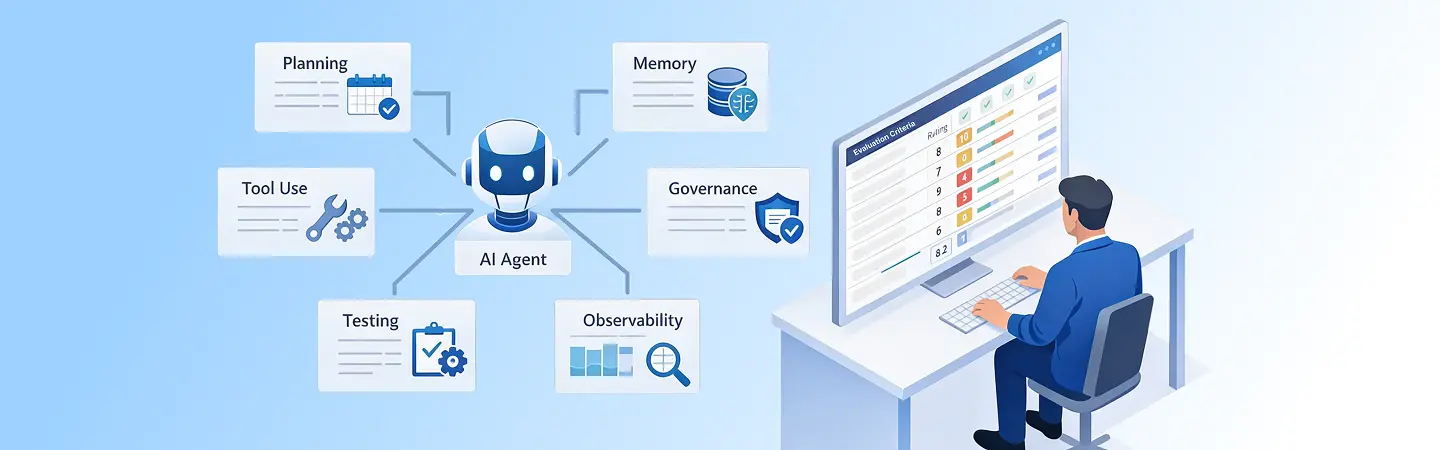
An AI agent isn't a chatbot. It's not a smarter autocomplete. It's a system that can perceive a situation, reason about what needs to happen, take action across tools and systems, and loop back when something goes wrong, all without a human in the loop for every step.
Think of it this way that a chatbot answers questions. An AI agent does things. For a SaaS company, that distinction is enormous. Because most of what burns your operational budget isn't answering questions, it's doing things. Repetitive, rule-adjacent, judgment-lite things that nonetheless require a human right now because software alone can't handle the edge cases
Agentic AI for SaaS closes that gap. It's the difference between "we have a help center" and "we have a system that resolves 60% of tickets before a human ever sees them."
The Hidden Costs Are Hiding in Plain Sight
Here's a simple exercise. Take your last full month of operational expenses and ask: which of these costs exist because a human had to do something a well-designed AI agent could handle?
Most SaaS teams find that the answer covers more ground than expected.
Customer support is the obvious one. The average SaaS company spends somewhere between $15–$50 per support ticket when you factor in fully-loaded agent cost, tooling, and management overhead. A lot of those tickets are about password resets, billing questions, feature confusion, and integration errors, all things an agent with access to your docs, your database, and your ticketing system can resolve autonomously.
Onboarding and activation is less obvious but arguably more expensive. Failed activations are invisible costs. When a user doesn't reach their aha moment, they churn quietly in month two or three. Companies without agentic onboarding flows rely on CSMs to manually monitor usage signals and reach out, which doesn't scale, and rarely happens fast enough anyway.
Internal operations might be the most underestimated bucket. Engineering teams manually running scripts. RevOps pulling reports every Monday. Finance reconciling invoices that almost-but-don't-quite match. Every one of these is a recurring, predictable task that an AI agent can be trained to handle end-to-end, with a human reviewing exceptions rather than doing the whole job.
When you add it up, and most SaaS CFOs haven't actually added it up, the number is usually uncomfortable.
Why "We'll Do It Later" Is More Expensive Than You Think
The cost of not adopting agentic AI isn't flat. It grows. And, that is a compounding problem.
As your product scales, your support volume scales. As your customer base diversifies, your onboarding complexity scales. As your team grows, your internal coordination costs scale. All of that is true with or without AI agents. But without them, your headcount has to scale in proportion. With them, it doesn't have to.
The SaaS companies that started deploying agentic AI for SaaS operations 18 months ago are now operating with significantly more leverage. Their support-to-ARR ratios are better. Their CSM-to-customer ratios are better. Their gross margins are better. And they've had 18 months of training data and iteration that you haven't.
Waiting isn't neutral. It's falling behind on a compounding curve.
Where to Actually Reduce SaaS Operational Cost with AI
If you want to reduce SaaS operational cost with AI without chasing shiny objects, start with three high-impact areas that most teams can move on quickly:
1. Tier-1 support deflection: This is the fastest win. Map your top 20 ticket categories from the last 90 days. Identify which ones require no external judgment, just access to product data, documentation, and account info. An agentic system can handle most of these autonomously, escalating only when it hits genuine ambiguity. Teams that do this right typically see 40–65% deflection rates within the first quarter.
2. Proactive onboarding nudges: Set up agents that monitor activation milestones and trigger contextual, personapzed outreach when users stall. Not email blasts. Not generic sequences. Actual responses to what a specific user did or didn't do in your product. This compresses time-to-value, which is probably the single biggest lever on early churn.
3. Internal workflow automation: Pick one recurring internal process that happens at least weekly, a report, a reconcipation, a data sync, a status update, and automate it with an agent that can handle exceptions with a human-in-the-loop checkpoint. Once you see it working, the flywheel starts. Teams that automate one process find five more within a month.
The key is not to start with a grand AI transformation strategy. Start with the specific, costly, repetitive thing that happens every week and drives someone slightly crazy. That's your first agent.
The Margin Math Is Hard to Ignore
Let's put some rough numbers on this, because efficiency is easier to dismiss than actual math.
Say you have a SaaS product doing $10M ARR. Your support team is eight people. Your onboarding/CS team is five people. Combined, that's somewhere around $1.5–2M in fully-loaded annual cost for those two functions alone.
Conservative estimates from teams that have deployed agentic AI suggest 25–40% cost reduction in those functions over 12 months, through a combination of deflection, automation, and leverage, not layoffs, but the ability to grow revenue without growing headcount proportionally.
That's $375K–$800K flowing back toward EBITDA. On $10M ARR, that's 4–8 points of margin improvement. For a company looking at a 5–7x revenue multiple, that translates directly to enterprise value.
And that's before you account for the revenue side: faster activation, lower churn, better expansion from proactively engaged accounts.
The Objection You're Probably Already Forming
"Our product is too complex for AI to handle."
Maybe. But probably not as much as you think. Most SaaS workflows that feel complex are actually rule-dense, not genuinely ambiguous. They have lots of conditions and edge cases, but those conditions can be mapped, documented, and reasoned over by an agent that has access to the right context.
The question isn't whether your entire operation is automatable. It's whether some meaningful slice of it is, and for virtually every SaaS company, the answer is yes.
"We don't have the engineering bandwidth to build this."
The barrier to deploying agentic AI has dropped dramatically in the last 18 months. There are orchestration layers, pre-built integrations, and platforms designed specifically to help SaaS companies deploy agents without rebuilding their infrastructure from scratch. The investment required is a fraction of what it was two years ago.
"We'll wait until the technology matures."
This is the most expensive mistake. The technology is already mature enough to deliver real ROI in production. What's not mature is your team's experience using it, and that gap only closes with time and practice.
The Bottom Line
There's a version of your SaaS business that runs leaner, scales faster, and retains more margin, not because you cut costs ruthlessly, but because you stopped paying a monthly tax for human labor on work that doesn't actually require human judgment.
That's what agentic AI for SaaS delivers when it's implemented thoughtfully. Not a science project. Not a future roadmap item. A present-tense operational advantage that compounds every month you have it and costs you every month you don't.
The EBITDA tax is real. The only question is how long you're willing to keep paying it.
Ready to Stop Paying the Tax?
If anything in this post felt uncomfortably familiar, the finance lead playing detective for the first five days of every month, the mid-market leads that get a generic "thanks for joining" and disappear, the engineer getting paged on a Friday night, we put together a resource specifically for you.
Unlock the 2026 Agentic AI Playbook by Invimatic





.svg)


.svg)
.avif)
Leave a Comment
Your email address will not be published. Required fields are marked *