


Your enterprise is paying six figures a year for software your team uses at 20% capacity. The other 80% is just features built for someone else's business. This is the build-vs-buy problem, and in 2026, the math is finally shifting.
The Hidden Cost of Off-the-Shelf Software
Let's start with a number that should bother every CFO in the room.
You don’t need a report to show you that your team hardly uses the tools you’ve
purchased to its full capability. A reality check into your process would be enough! For large, complex platforms like SAP and Salesforce, that number is often lower. You're not just paying for what you use, you're subsidizing a product roadmap designed for the median customer, not your business.
But the licensing fee is just the visible cost. The hidden costs compound quietly:
- Implementation: A mid-sized SAP deployment averages $500,000 to over $3 million before a single employee logs in, according to 20026 reports.
- Customization: Every time you bend an off-the-shelf platform to fit your workflow, you pay a consultant. Then you might have to pay again when the vendor releases an update that breaks the customization.
- Training: Generic platforms have generic interfaces. Your team spends weeks learning software designed for a hypothetical user, not their actual job.
- Vendor lock-in: Your data, your workflows, and your institutional knowledge get encoded into a system you don't own. Switching costs become a form of captivity.
None of this shows up on the invoice. All of it shows up in productivity, morale, and the quiet frustration of ops teams working around software instead of with it.
We have created a playbook that outlines how we can help make an informed decision. No pitch, just a plan.

Side-by-Side: Custom Build vs. SAP vs. Salesforce
The 3 Signs It's Time to Replace Your Tool
Not every enterprise needs to build. But these three signals mean you probably should.
- Your team has built workarounds on top of your software
When employees are maintaining spreadsheets alongside Salesforce, or exporting SAP data into Google Sheets to do actual analysis, the software has failed its core job. Workarounds are not a user problem. They are a product-fit problem. If your ops team has a system that involves copying data between platforms every Monday morning, that system is your real workflow, and it deserves to be built properly. - Your customization costs are approaching your licensing costs
This is a crossover point that most enterprises hit and ignore. When your annual Salesforce consultancy bill is within 50% of your licensing fee, you are paying twice for the same problem. At that spend level, a custom-built system becomes not just a preference but a financial decision. - Your software can't accommodate your AI strategy
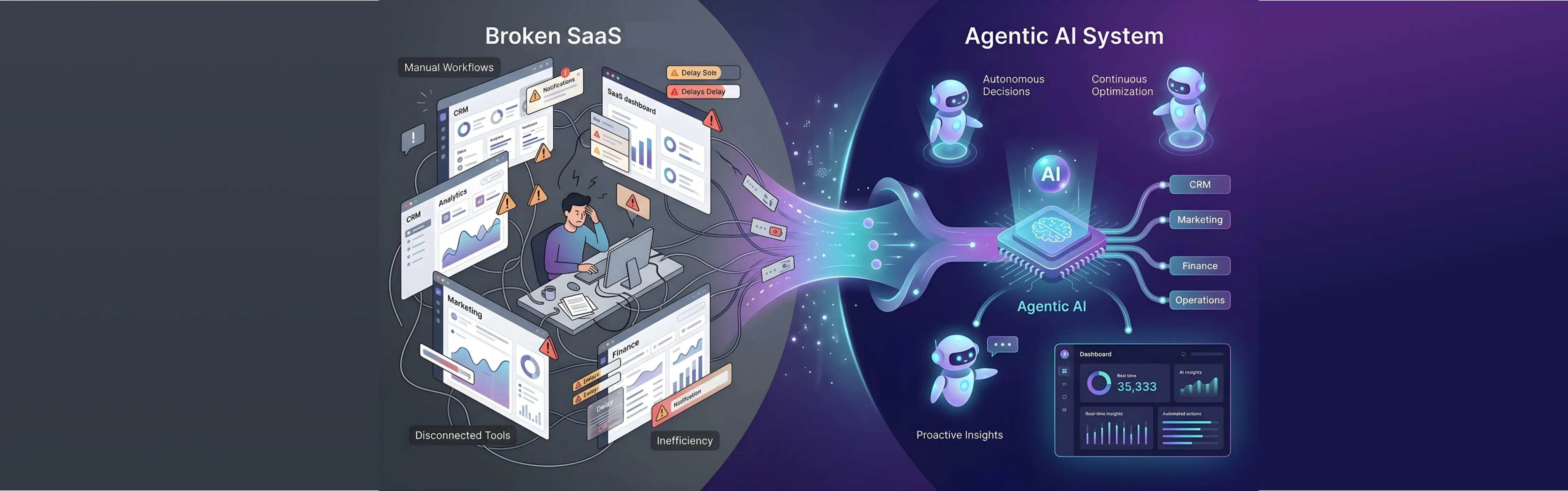
This is the new one, and it's the one moving fastest. Enterprises are now building agentic AI workflows, which basically are AI systems that don't just answer questions but take actions, make decisions, and operate across systems autonomously. Off-the-shelf platforms are adding AI features reactively, as bolt-ons. They were not architecturally designed for agentic AI development. If your AI strategy depends on a vendor's roadmap, you don't have an AI strategy, you have a feature request.
What Data Ownership Actually Means for Your Business
"You own your data" appears in almost every enterprise software contract. What it means in practice is more complicated.
When your operations run on SAP or Salesforce, your data lives in their cloud architecture, formatted according to their schema, accessible through their APIs, and subject to their terms of service. You can export it, usually. But extracting it in a usable format, at scale, without disruption to operations, is a project in itself.
For most enterprises, this matters in three specific ways:
- AI training. If you want to build a custom AI model on your operational data, your historical transactions, your customer interactions, your supply chain patterns, you need clean, accessible, portable data. Data locked inside a vendor's architecture is not AI-ready data. It requires extraction, transformation, and cleaning before it can be used. That's time and cost that custom-built systems eliminate entirely.
- Regulatory compliance. In healthcare, financial services, and defense contracting, data residency requirements are not suggestions. Knowing exactly where your data is, who can access it, and how it's processed is a compliance requirement. Shared cloud infrastructure makes that harder to guarantee than a system you control entirely.
- Switching leverage. When your data is portable, you have options. You can switch vendors, build internally, or integrate new tools without negotiating an exit. Vendor lock-in is, at its core, a data portability problem. Owning your architecture means owning the choice.
Where Agentic AI Development Changes the Equation
The build-vs-buy calculation has always existed. What's new is the AI layer, and it fundamentally changes what "building" means.
Modern custom software isn't just a database with a better interface. Built correctly, it becomes the foundation for agentic AI workflows: systems where AI agents operate
across your data, your processes, and your integrations with the autonomy to get things done.
Building trust with agentic AI requires that the AI has access to clean, structured, proprietary data, the kind that only lives in systems you own and control. An AI agent trained on your customer history, your pricing logic, your fulfillment patterns, and your compliance rules is categorically different from an AI assistant bolted onto a third-party platform.
This is what a specialist agentic AI development company builds toward: not just software that works, but software that becomes increasingly intelligent as it accumulates your institutional knowledge, rather than sharing it with a vendor's product roadmap.
The Bottom Line
SAP and Salesforce, and gazillions of other similar software are not bad products. They are products built for the average enterprise, which means they fit no enterprise perfectly.
For companies with standard processes and high feature utilization, off-the-shelf software remains a reasonable choice. For companies with specialized workflows, serious AI ambitions, or mounting customization costs, the math has shifted. Custom software is no longer the expensive, risky path. In many cases, it is the more affordable, more controllable, and more strategically sound one.
The question isn't whether you can afford to build. It's whether you can afford to keep paying for software built for someone else.
Invimatic helps enterprises replace legacy platforms with custom software and agentic AI systems built specifically for how their business operates. Talk to us about your build-vs-buy decision.



.svg)


.svg)
.avif)

Leave a Comment
Your email address will not be published. Required fields are marked *